Stop Starving Yourself and Start Lifting Weights
Why High-Intensity Resistance Training Is the Best Way to Achieve Your Physique Goals

When most people decide to lose weight or start a fitness journey their first instinct is to immediately make drastic changes to their diet. Carbs get cut, sugar is eliminated, and calories drop way below what the body actually needs. While this may seem like the fastest path to results, it often sends people in the exact opposite direction of the physique they want.
If your goal is to lose body fat and achieve an athletic build, starving yourself isn’t the answer; high-intensity resistance training, paired with proper nutrition and recovery, is.
Drastically cutting calories or relying heavily on cardio often leads to a “skinny-fat” physique. This happens when the scale goes down, but because muscle isn’t being built, the body looks softer and less defined.
For most aesthetic goals, better results come from building muscle while maintaining a slight caloric deficit. Muscle is what gives your body shape and definition, and developing it requires intention and consistency — NOT extreme caloric restrictions.
To build muscle effectively, there are three must-dos:
Training with intensity
Eating a well-balanced diet
Prioritizing recovery
1. Training With Intensity
Training with intensity means challenging your muscles enough to force them to adapt and grow. Light weights or cardio focused exercises performed casually won’t create the stimulus your muscles needed to change.
You grow muscles (hypertrophic gains) from progressive overload. This is lifting heavier weights, increasing reps or sets, or making exercises more challenging over time. According to a study in the National Library of Medicine, performing 3–4 sets of 8–12 reps provides the most optimal stimulus to grow your muscle size while also boosting your metabolism.
To train with the most intensity and provide stimulus to your muscles, it is important to use weight that is 60% to 80% of your one-rep-max. This means if your 1RM for squat is 200 lbs then your workout program would look like performing 3-4 sets, of 8-12 reps, with 120 lbs to 160 lbs.
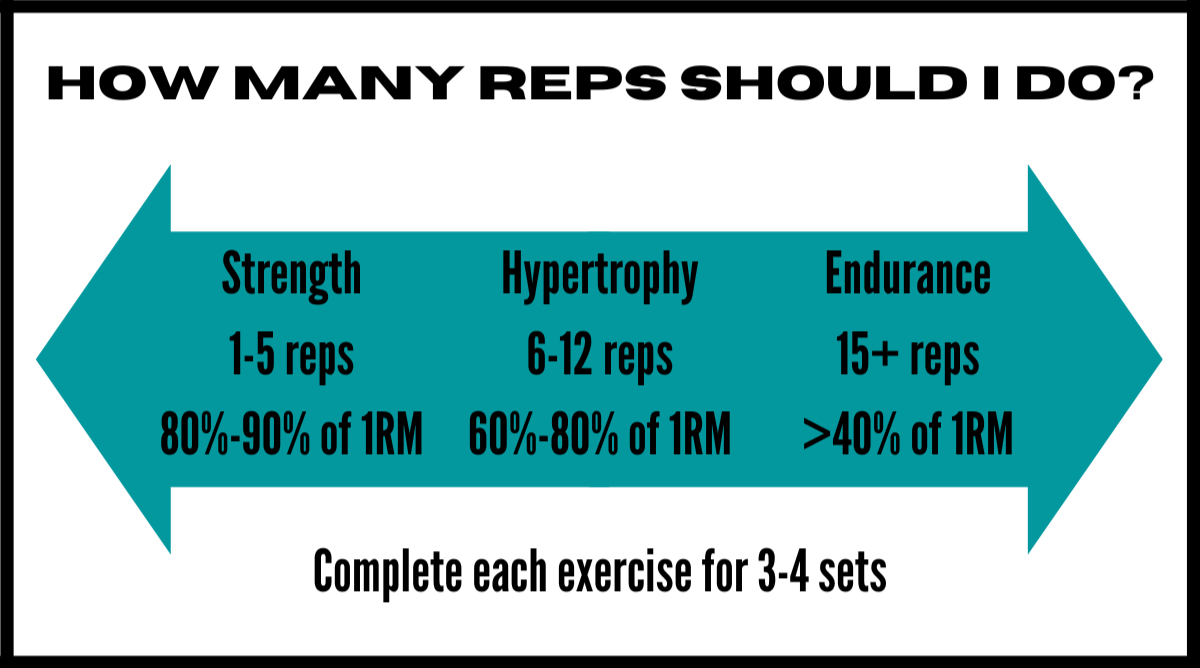
This is an easy guide to know how much weight, and how many reps and sets you should do dependent on your fitness goals.
2. Eating a Well-Balanced Diet
Muscle doesn’t grow without fuel. Protein provides the amino acids your body needs to repair and build muscle tissue. Carbohydrates are your body’s main energy source during resistance training, supporting performance and replenishing glycogen for recovery. Fats are essential for overall health: hormone production and energy. Each one is essential for a well-balanced diet and depleting one from your meals is unhealthy.
When calories or nutrients are too low, muscle growth and fat loss stall no matter how hard you train. Eating a balanced diet with protein, carbohydrates, and fats allows your body to perform, recover, and build the muscle that create the physique you’re looking for.
3. Prioritizing Recovery
Muscles don’t grow during workouts; they grow when you rest. Sleep, proper nutrition, and rest days are when your body repairs damaged muscle fibers and builds them back stronger. Skipping recovery is one of the fastest ways to prevent seeing optimal progress and also a fast-tracked way to injury.
Without all three of these components, the number may drop on the scale, but you will be leaving optimal results on the table. To make sure your hard work in the gym pays off, it’s important to know what you should be eating and how much. Understanding your daily calorie needs is the first step to fueling your body properly, supporting muscle growth, and achieving the results you’re working for.
How to Properly Gauge What You Should Be Eating
One of the most confusing parts of any fitness journey is figuring out what — and how much — you should eat. How do you create a healthy relationship with food without restricting everything you love or constantly overeating?
It starts with understanding your calorie needs.
Step 1: Find Your Calorie Target
Using an app like MyFitnessPal can help estimate your daily calorie needs. These calculators use your age, height, weight, sex, activity level, and goals to determine a daily target.
Daily calorie needs are based on your resting energy requirements and adjusted for how much you move throughout the day.
A general rule to remember:
3,500 calories = approximately 1 pound of fat
If your goal is to lose 1 pound per week, you’ll need a daily deficit of about 500 calories. For example, if your maintenance calories are 3,000 per day, eating around 2,500 calories would support that goal.
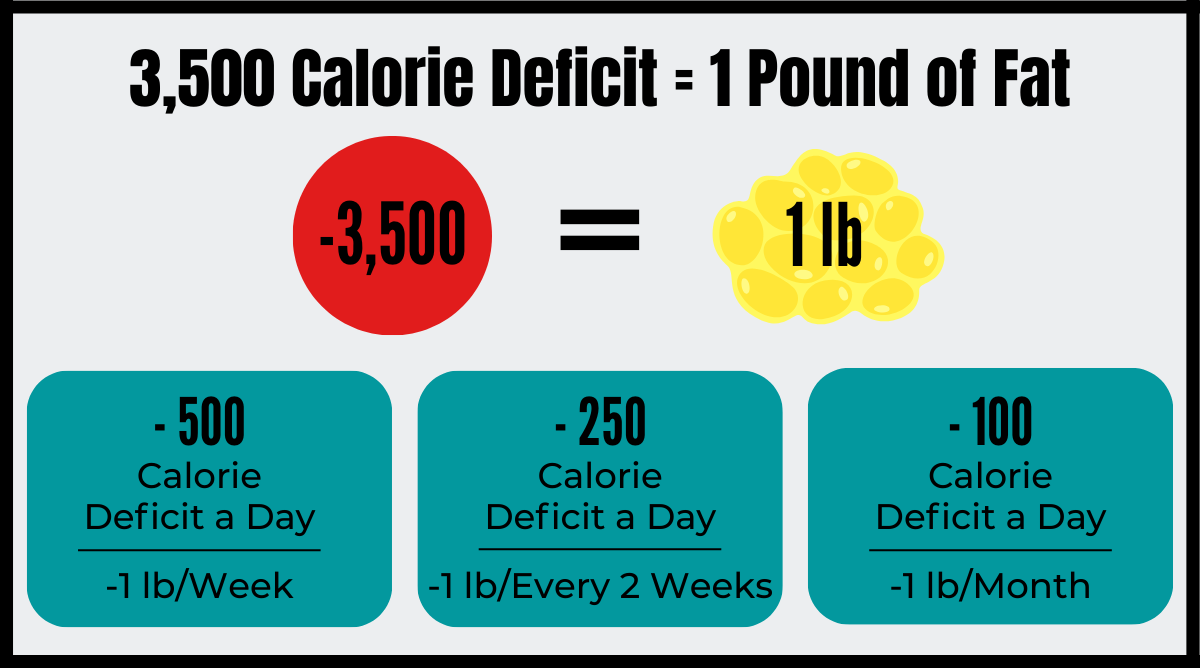
A 3,500 calorie deficit equals roughly 1 pound of fat. Choose a pace that fits your lifestyle.
Step 2: Make Small, Sustainable Changes
You don’t have to jump straight into a 500-calorie deficit. Starting with a smaller deficit, and small nutritional changes, can still produce results while going at a pace that works best for you.
Some simple examples:
If you drink soda with every meal, cut back to one per day or switch to diet soda.
If you use whole milk, transition to 2%, 1%, or fat-free.
If your usual fast-food order includes five tacos, try ordering three.
Small changes add up and allow progress without feeling deprived.
Why Extreme Calorie Restriction Backfires
When you restrict calories too aggressively, your body adapts by slowing down your metabolism. Energy levels drop, workouts suffer, and muscle-building becomes nearly impossible. Instead of building muscle, you may actually lose it.
On top of that, extreme restriction isn’t sustainable. You might maintain it for a few weeks, or even a couple of months, but eventually hunger, cravings, and burnout take over. This often leads to overeating and restarting the cycle, and maybe even gaining more weight than when you started.
Rather than chasing short-term results, focus on habits you can maintain for life. Avoid fad diets that eliminate entire food groups and instead build a balanced approach that fuels your training, supports muscle growth, and keeps you feeling strong.
The goal isn’t to eat less, it’s to eat healthier, lift heavier, and train with purpose.